General intelligence, is a relative indicator of how well a person can learn new information and perform daily tasks. Experts convey there are many types of mental abilities.
Intelligence is dependent upon the subject's ability to quickly and accurately process and understand information via visual and auditory pathways.
Understanding depends on the ability to retain enough "chunks" of information in short-term memory, long enough, to make sense of it, to act on it,
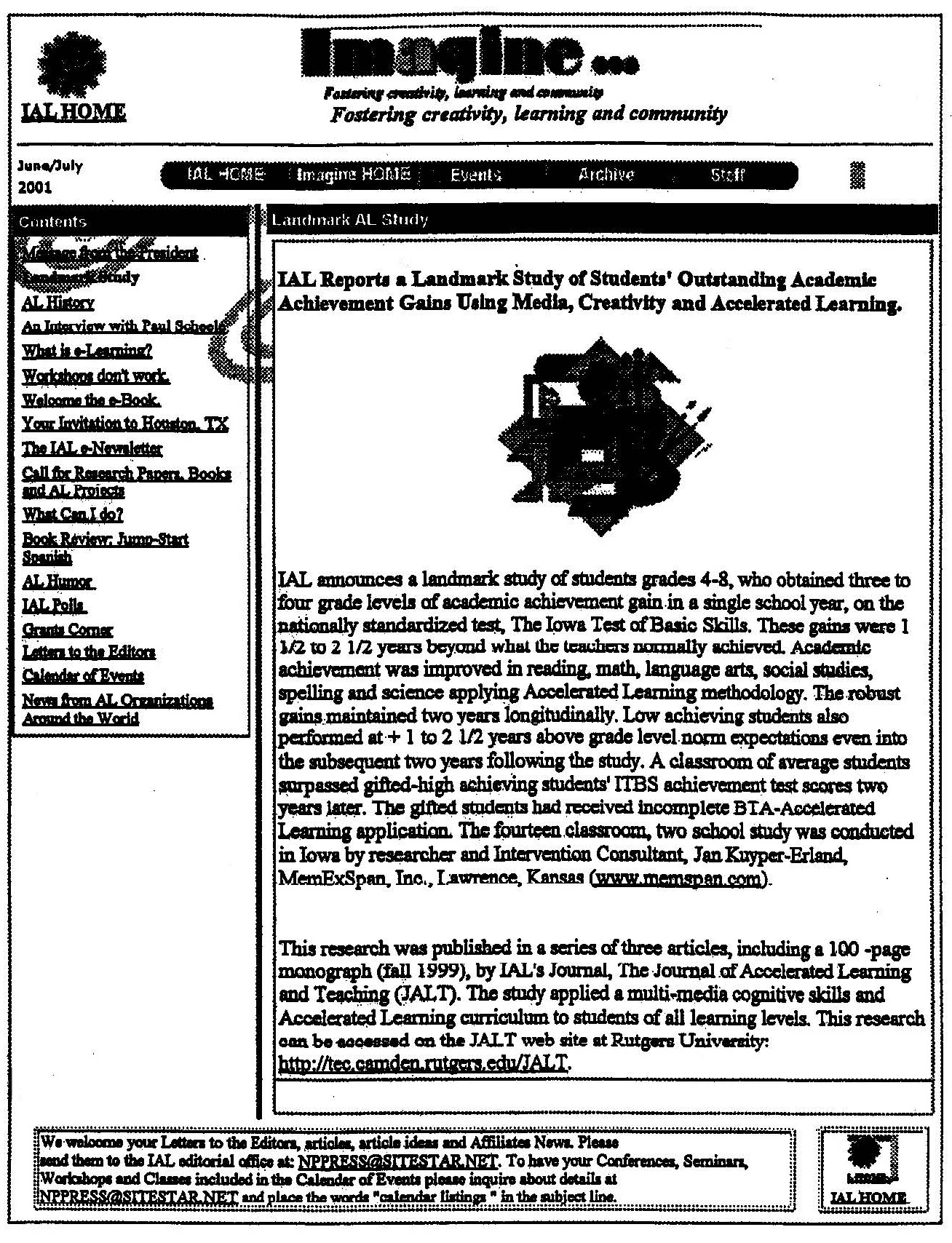
and finally to commit it to long-term memory. Low level information processing skills, also known as cognitive skills, are measurable and trainable. Outcome-based results are outstanding with + 3 to + 4 years academic achievement growth in reading, science, language arts, social science, and math in a single years time. (+ 1 to + 1 1/2 years growth beyond what the teachers normally obtained. See JALT Fall 1999)
The BTA ® Program Benefits:
Visible results using nationally standardized tests
Improve reading skills without additional remedial reading instruction
Improve mathematics skill without additional remedial math instruction
Improve numerical precision and mental calculating ability
Improve listening skills
Improve accuracy of short-term visual memory
Improve ability to follow oral instruction
Improve ability for accuracy for detail in written work
Improve visual pattern recognition and visual closure
Improve visualization skills
Improve short-term verbal memory for detail
Improve accuracy of short-term verbal memory
Improve identification of spoken word endings
Improve sense of directionality (and handwriting often improves)
Improve ability to translate from verbal to visual memory representation
Increase ability to remember information through interruptions
Increase student's overall ability
Student Perspective:
Visible results using nationally standardized achievement tests
The Student:
Feels more successful and likes going to school
Able to learn more in less time, with more independence
Able to complete assignments quickly
Able to learn more in a traditional classroom
Develops improved confidence and self esteem
Able to become more successful in college
Performs better on tests of subject matter knowledge
Able to focus and work through interruptions and distractions
Remembers and applies strategies for processing and organizing information
Parental Perspective:
Student attitudes toward school improve
Homework is completed with less urging and assistance
Student's grades improve
The classroom teacher receives more respect and credit
Perceive more value being received from the school
Less worry that student is falling behind college or technical school entrance requirements
Less concern that student is not in step with technological demands
School Perspective:
Visible results using nationally standardized tests
Students become more resourceful and independent
Students become more successful and optimistic about education
Fewer discipline problems
Reduction in the student drop-out rate
Reduce student reading impairments
Reduce student learning disabilities, ADHD
Reduce remedial instruction requirements
Simplify student scheduling
Increase success with main-lining the special needs students
Allow more education resources to be directed to the most needy students
Make the job of classroom teachers more manageable and less stressful
Improve overall Nationally Standardized Achievement Test results
Raise overall student ACT and SAT scores
Raise the school ranking at the district, state and national levels
Student/Cost Analysis: Increase the educational return (student learning) on investment (dollars spent on students)
Increase parental satisfaction with school and student performance
More scholarships, grants and other student aid received by graduates
Increase completion rate of post-secondary education
Reduce requirement for college-level remedial courses
Increase competitiveness of the school
Societal Perspective:
Visible results using nationally standardized tests
Develop higher skilled work force
Workers become more flexible in the work they can do
Workers make fewer mistakes
Workers have more self confidence and self respect
Businesses may spend less on basic skills remedial education
Workers become easier to retrain for changing job needs
More people enter professional careers
Fewer people become or remain dependent upon social services
Fewer people become clients of the criminal justice system
Ratio of social services independent versus dependent citizens moves toward independence and autonomy
The cost of government services for unemployed and unemployable lower
Business unemployment insurance costs decrease
Public attitude toward education is improved as student test scores increase
More people apply Life-Long Learning by use of libraries, community, and university education options
GO BACK TO HOME PAGE
Jan Kuyper Erland, M. S.
Intervention Consultant
Mem-ExSpan, Inc.
The Bridge To Achievement ®
Tel: 785-749-5402
email: jan@memspan.com
www.memspan.com